

· AFX Research
Why a Title Search Needs the Legal Description
A street address is a mail delivery label, not a property identifier. Here is why the recorder's index runs on legal descriptions, what happens when the two disagree, and where to find yours before you order a search.
Table of Contents
Almost every title search order starts with a street address, and almost every one of them should also carry a legal description. The address tells the mail carrier where to go; the legal description tells the recorder which piece of ground you mean. Those are different jobs, and on a meaningful minority of orders the difference is what stands between a fast, accurate report and a second round of questions.
What an address can’t do
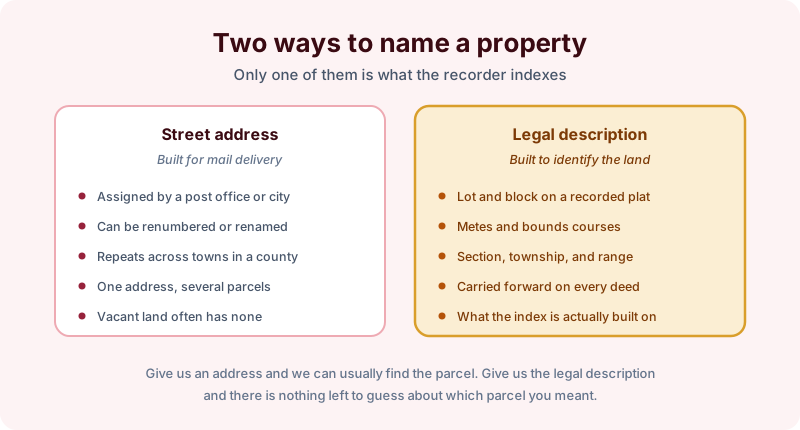
Addresses are assigned by a post office or a municipality, and they change. Streets get renamed, blocks get renumbered after annexation, and a rural route address from 1990 may bear no resemblance to today’s 911 addressing. None of that touches the deed.
Addresses also repeat. A county with a dozen incorporated towns can easily hold four instances of 100 Main Street. And one address can sit on several parcels, or a parcel can hold several addresses, which is normal on corner lots, split lots, and anything with a duplex on it. Vacant land frequently has no address at all.
What the legal description does
A legal description identifies the land itself, in one of a few standard forms: lot and block on a recorded plat, metes and bounds courses, or a section, township, and range reference. Whichever form it takes, it gets carried forward on each deed as the property changes hands, which is precisely what makes a chain of title traceable across decades.
That is why the recorder’s index is built on it. Searching by address is a lookup step that lands on a parcel; searching the parcel is the actual work.
When the two disagree
This is the situation worth planning for. A parcel was split and the new lot kept the old address. A deed carries a description that no longer matches the current plat after a lot line adjustment. Two adjacent parcels are used as one property but were never legally combined, so a search of the address covers one of them and misses the other entirely.
None of these are exotic. They surface regularly on rural land, older subdivisions, and any property that has been reconfigured, and they are exactly the kind of thing a report should flag rather than quietly resolve. Discrepancies like these belong in the list of problems worth catching early.
Where to find yours
The most reliable source is the last recorded deed, where the description usually appears right after the grantee names. A property tax bill or assessor record generally carries the parcel number and often an abbreviated description, and a title policy or prior commitment will have the full text in Schedule A. A survey has it too.
If you have the deed, send it. A parcel number alone is a strong second, since it maps to the assessor’s parcel and gets us to the same place.
The bottom line
Send an address and we can almost always find the parcel; send the legal description or the parcel number and there is nothing left to guess about which one you meant. It is the single cheapest thing you can do to keep a search inside its usual turnaround. Order online with whatever you have, or ask us if the property has been split, combined, or reconfigured and you want the scope confirmed first.