

· AFX Research
Title Search for a Property Under a Recorded Option
A recorded option gives somebody else the right to buy the property out from under your sale. What the record shows, why options that expired decades ago keep appearing as exceptions, and how a search reads one.
Table of Contents
An option to purchase is a standing right to buy on fixed terms, held by somebody who has not bought anything yet. When it is recorded, it attaches to the parcel in the sense that matters most, which is that every later buyer takes with notice of it. Finding one mid-transaction is unwelcome, and finding one that expired twenty years ago and was never released is more common still.
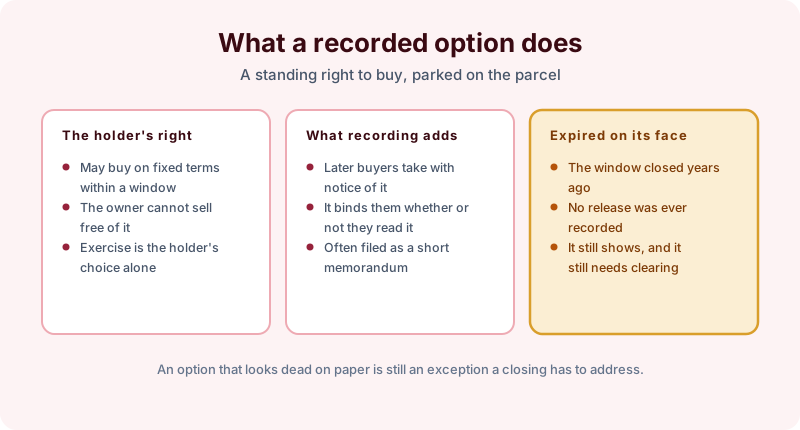
What an option actually gives
- A one-sided right. The holder may buy within a window, on terms already written. The owner is bound; the holder is not.
- Priority by recording date. An option recorded before your contract generally outranks it.
- Notice that binds strangers. A buyer who never read it is still charged with knowing what the record held.
Options differ from the right of first refusal covered in our note on right of first refusal and your title search. A refusal right only activates when somebody else offers. An option can be exercised whenever the holder likes.
Why they linger in the record
Most recorded options are never released. The window closes, the holder loses interest, and nobody files anything, so the memorandum sits in the index indefinitely looking live. Title examiners treat an unreleased option as an exception even when it is plainly stale, because the recorded document is the evidence and an assumption is not.
That matters at closing. Clearing one usually means a recorded release from the holder, or an affidavit, or occasionally a quiet title action, and tracking down a holder who moved on decades ago takes longer than anyone budgets.
Where they turn up most
Development land is the obvious one. A builder ties up several adjoining parcels with options while assembling a site, exercises on two of them, and walks away from the rest without clearing anything.
Long leases are the quieter source. A commercial tenant negotiates an option to purchase inside the lease, a memorandum of the lease gets recorded, and the purchase right travels with it. The index entry says lease, and the option is three pages in.
Family arrangements are the third. A parent sells to one child and records an option letting a sibling buy later at a set price. Those sit in the record for a generation.
What the search returns
We report the option or its memorandum with book, page and recording date, the parties named, the stated term where the document gives one, and any release, extension, assignment or exercise found of record. We also report what sits around it, since an option recorded between two mortgages has a position.
A search reports what has been recorded in that county. It cannot tell you whether an option was exercised privately, whether the parties treated it as abandoned, or whether it is enforceable today. Recording practice varies by county, and the legal effect of a particular option is a question for an attorney.
The bottom line
Pull the full instrument rather than the index entry, check for a release before assuming age killed it, and start the cure early. Order online, or ask us and we will tell you what scope the question needs.