

· AFX Research
Title Search When a Property Has No Street Address
Vacant and rural parcels frequently have no address at all, which is not an obstacle. The legal description is what identifies land, and supplying the right one is the whole job.
Table of Contents
A buyer asks whether a parcel can be searched when it has no street address. It can, easily, and the question reveals a common misunderstanding worth correcting. Addresses are assigned by municipalities and postal authorities for delivering mail. They do not convey land, they do not appear in most deeds, and they change for reasons that have nothing to do with ownership.
The legal description is what identifies property, and it always has.
Why a parcel has no address
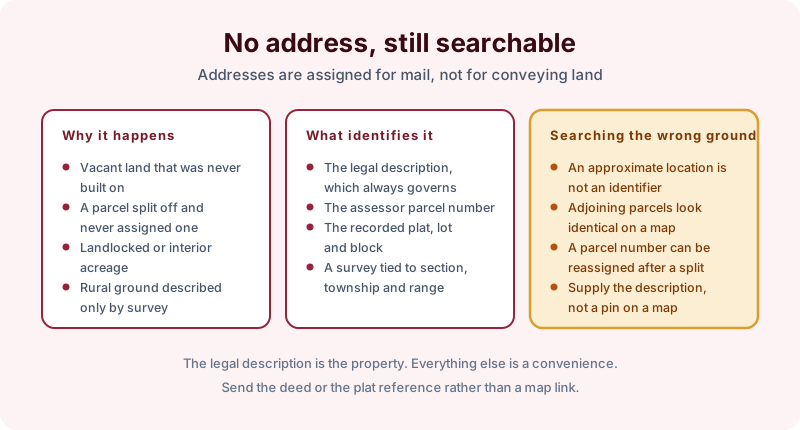
Vacant land that was never built on has no reason to have one. A parcel split off from a larger tract frequently waits for an address until somebody applies for a building permit. Landlocked or interior acreage may never get one. And rural ground described only by survey can go a century without anybody assigning a number to it.
None of that affects whether it can be conveyed, mortgaged, liened or searched.
What identifies it instead
The legal description, which governs in every case and is what appears in the deed. Metes and bounds, lot and block from a recorded plat, or a call to section, township and range in the public land survey states.
The assessor’s parcel number, which is a useful pointer and nothing more. It is assigned for billing, it is reassigned freely after a split or a merger, and it has no legal effect on what was conveyed.
The recorded plat, where one exists, which ties the lot to a surveyed drawing on file.
The real risk
Searching the wrong ground, which is a genuine and under-appreciated hazard on unaddressed parcels.
An approximate location is not an identifier. Adjoining vacant parcels look identical on any map. A parcel number may have been reassigned after a split, so the number on a four-year-old tax bill may now point at different acreage. And a pin dropped on a mapping app is an inference about a boundary, not a description of one.
The result is a search that is performed correctly on land that is not the land you meant — which produces an accurate report about somebody else’s property and no warning that anything went wrong.
What to send us
The legal description, copied in full rather than summarized. A copy of the current deed is the easiest way to supply it. Where the parcel is in a platted subdivision, the plat reference with lot and block. The assessor parcel number as a cross-check rather than as the identifier. And the county, which on unaddressed rural ground is worth confirming rather than assuming.
A records search reports what was recorded and indexed as of the day it was run, against the description supplied. It does not locate the parcel on the ground, which is a survey.
The bottom line
No address is not a complication. Sending a map link instead of a legal description is. See the full range of searches and order online, or ask us how to identify a parcel you only have a location for.