

· AFX Research
How Far Back Does a Title Search Go?
There is no single answer, because depth is something you choose when you order. Here is what each common scope covers, what sets the outer limit, and how to pick the right one for your transaction.
The honest answer is that a title search goes back as far as the search you ordered, and no farther. Depth is a parameter, not a fixed property of the records, and the difference between a search covering eight years and one covering sixty is the difference between two entirely different products at two different prices.
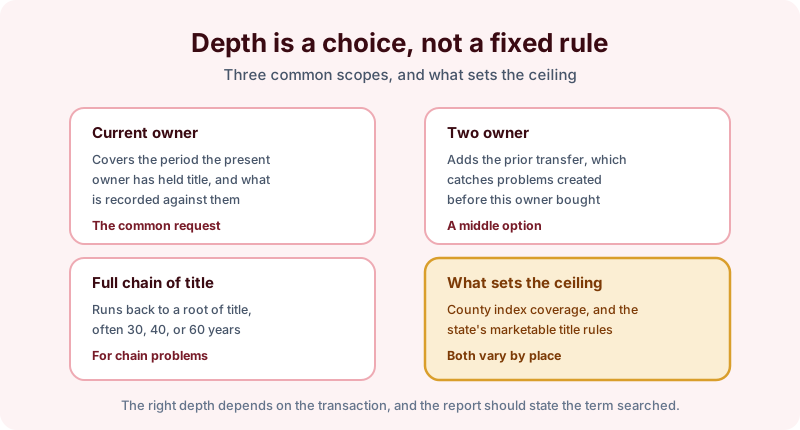
The three common scopes
A current owner search covers the period the present owner has held title: how they acquired it, and what has been recorded against them and the parcel since. It answers the ordinary question of what has to be cleared to close, and it is what most transactions actually need, as our note on what a current owner search is explains.
A two owner search adds the transfer before that one. It picks up problems created by the prior owner that were never cleaned up, which is where a surprising share of defects live.
A full chain of title runs back to a root of title, commonly thirty, forty, or sixty years depending on the state. It is the right tool when the chain itself is the question: gaps, heirs, old easements, mineral reservations, or a quiet title action. Our note on current owner versus full chain compares them side by side.
What sets the outer limit
Two things, and both vary by place. County index coverage is the practical one: records exist, but older volumes may be paper only, indexed by grantor and grantee rather than by parcel, and organized in ways that make a deep search a manual job rather than a database query.
The second is state law. Many states have marketable record title acts that define a root of title after a stated period, which is the reason a “full” search has an endpoint rather than running to a colonial land grant.
Choosing the depth
Match it to what can go wrong in your deal. A refinance on a house bought six years ago usually needs the current ownership period. An inherited property, a parcel that has been vacant for decades, rural land, a foreclosure or tax deed purchase, or anything where you suspect a break in the chain is worth more depth. So is any property where mineral or easement rights matter, since those instruments are frequently old.
One thing to insist on regardless of scope: the report should state the term it searched. A finding of nothing over eight years and a finding of nothing over sixty are different facts, and a report that does not say which one it is has left out something important.
The bottom line
Decide the depth before you order, based on the risk you are trying to price rather than on habit. If you are not sure, tell us what the transaction is and we will tell you which scope answers it. Order online, compare the report options, or ask us first.