

· AFX Research
Title Search Before a Home Equity Investment
A home equity investment records a real lien against your house even though it has no monthly payment and no interest rate. What shows up in the record, what stays in the agreement, and why it matters at refinance.
Table of Contents
A home equity investment gives a homeowner cash today in exchange for a share of the home’s future value. There is no monthly payment and no stated interest rate, which leads a lot of people to file it mentally alongside a grant rather than a loan. The county record disagrees, and so will your next lender.
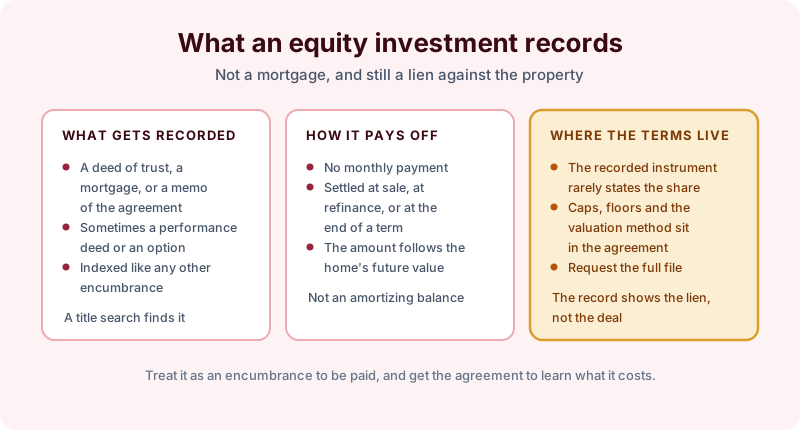
What actually gets recorded
The investor protects their position by recording something against the property — a deed of trust, a mortgage, a memorandum of the agreement, or in some programs a performance deed or an option. Whatever it is called, it is indexed against your parcel like any other encumbrance, and it shows up in a search exactly the way a second mortgage does.
That is the point of recording it. It puts the world on notice, and it means the obligation gets paid before the property changes hands clean.
What the record will not tell you
Here is the gap that catches people. The recorded instrument usually secures the agreement without reciting its economics. The percentage of appreciation, the starting valuation, any risk adjustment to that valuation, caps, floors, the term, and the method for appraising the home at exit are all in the agreement, and the agreement is not recorded.
So a title search can tell you with confidence that a lien exists, who holds it and when it was recorded. It cannot tell you what it will cost to clear. For that, you need the agreement itself and a payoff quote from the investor.
Where it bites
At refinance. A new first-lien lender will require the investment to be paid off or subordinated, and subordination is the investor’s decision rather than yours. Plan for that before you shop rates, the same way a HELOC or home equity loan has to be dealt with.
At sale. The payoff is calculated against the sale price or an appraisal, so the number is not knowable until late. Sellers who budgeted from the original cash advance are routinely surprised.
At death or divorce. The obligation stays with the property, and the recorded instrument is what a successor or a settlement has to work around.
Before you sign, and after
Before signing, run a search so you know what is already recorded. An existing second mortgage, a judgment, a tax lien or a contractor’s claim all affect whether the investor will fund and in what position, and title problems a current owner search catches covers the usual suspects.
After closing, confirm the instrument was actually recorded and that it describes the right parcel. And when the obligation is eventually paid, check that a release was recorded. An unreleased lien from a satisfied obligation is one of the more common defects we find.
The bottom line
Treat a home equity investment as an encumbrance that will have to be cleared, because that is how the record treats it. A search shows what has been recorded against the property; it is not a reading of what your agreement costs, and an empty result does not prove nothing exists. Order online, or ask us which search fits before anything is ordered.