

· AFX Research
Should You Run a Title Search Before Listing?
Sellers usually meet their own title problems inside escrow, when a fix costs time and leverage. What a pre-listing search finds, what it costs you to know early, and when to skip it.
Table of Contents
Buyers order title searches. Sellers usually do not, which is why so many sellers first learn about a thirty-year-old unreleased mortgage from an escrow officer with a closing date fourteen days out. Every problem a pre-listing search finds is a problem you were going to have anyway — the only variable is whether you meet it on your schedule or the buyer’s.
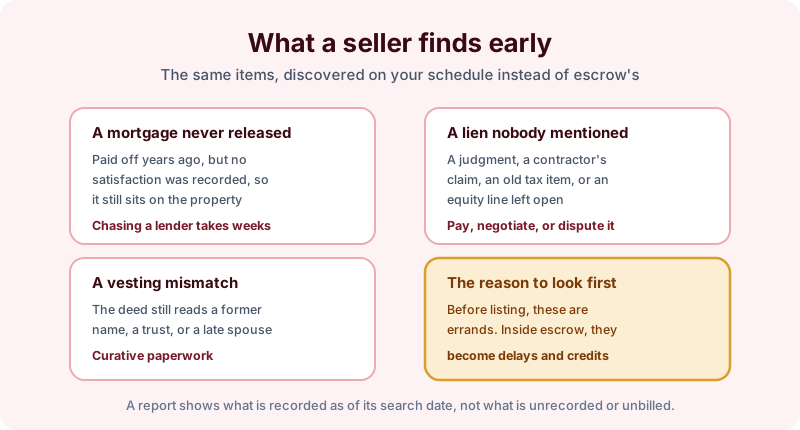
What tends to turn up
Three findings account for most of it. A satisfaction that was never recorded, so a paid-off loan still appears against the property. A lien nobody remembered: a judgment, an old tax item, a contractor’s claim, an equity line left open at zero balance. And a vesting mismatch, where the deed still reads a maiden name, a former spouse, a decedent, or a trust that was never funded properly.
None of these are exotic. They are the ordinary residue of a property owned for twenty years, and they are exactly the problems a current owner search catches. A fourth shows up on older parcels: a legal description that reads inconsistently across two or three instruments, usually from a lot split or a corrected survey that never made it into every deed.
Why the timing changes the cost
Outside a transaction, an unreleased mortgage is an errand: locate the lender or its successor, request the release, record it. It may take weeks of waiting, but nothing is at stake while you wait.
Inside escrow the same item is a delay, and a delay is leverage. Buyers ask for credits, extensions, or a holdback. Some walk. Nothing about the record changed — only your position did.
The waiting is the part sellers underestimate. Recording a release you already hold takes a day; getting a successor institution twice removed to produce one can take a month of phone calls, and no amount of urgency shortens it.
What it does not do
A search reports what is recorded as of the search date. It will not find an unrecorded agreement, a boundary dispute nobody filed, or a claim that exists only in a relative’s head, and an empty result is not proof that no claim exists.
It also is not a substitute for the buyer’s own search or for title insurance. Think of it as reading your own file before someone else reads it aloud to you, and remember that a report is accurate as of its date, so a long listing period may deserve a refresh.
When to skip it
If you bought within the last two or three years with a lender and a title policy, the record was examined recently and the odds of a surprise are low. Long ownership, inherited property, a divorce, a refinance with a small local lender, or any period of financial trouble points the other way. So does an unusual vesting — a property held by an LLC or a trust has more ways to be recorded imperfectly.
When in doubt
A pre-listing search is cheap relative to a two-week escrow extension, and the report is useful either way: clean means one less unknown, and a finding means you get to fix it while nobody is waiting on you. Order online, or ask us what a search on your property would include before you decide.