

· AFX Research
Title Search for a Community Land Trust Home
In a community land trust the nonprofit keeps the land and you buy the house on a long ground lease, with a recorded formula capping what you can sell it for. Here is what the county record shows and what it cannot settle.
Table of Contents
A community land trust home is two interests stacked on one address, and the one that controls your resale is a lease rather than a deed. The model is deliberate and it works well for the people it is built for, but it reads strangely in a title report if you are expecting ordinary fee ownership, and the differences are the kind that matter at a closing.
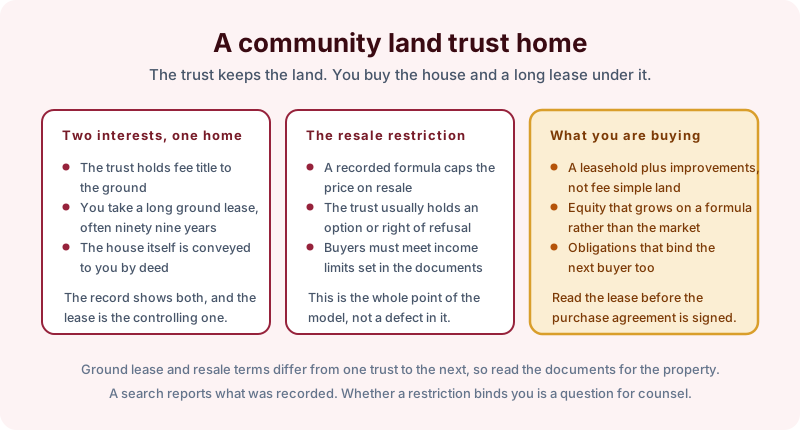
What the record shows
The trust holds fee title to the ground. You take a ground lease under it, typically ninety-nine years and usually renewable, and the house itself is conveyed to you by deed. Both appear in the county record, and the lease or a memorandum of it is what a search finds against the parcel.
That structure has a close cousin in an ordinary ground lease or land lease purchase, with one difference that changes everything. A commercial ground lease is priced at market. A community land trust lease carries a resale restriction.
The resale formula
A recorded formula caps what you can sell for. The common versions give the seller a share of appreciation rather than all of it, so the house stays affordable for the next household. The trust usually also holds an option or a right of first refusal, and the next buyer has to meet income limits written into the documents.
This is the point of the model and not a defect in it. It does mean your equity grows on a formula instead of on the market, and it means the restriction binds whoever buys from you. A right of first refusal behaves much the way it does in right of first refusal and your title search, except that here it is permanent rather than a term of years.
What a search can and cannot settle
A search establishes what is recorded. The fee owner of the ground, the lease or its memorandum, the deed to the improvements, the recorded resale restriction, any mortgage you or a prior leaseholder granted, and the liens and judgments found against the parcel over the term searched.
It does not interpret the lease. Whether a particular resale formula applies to a given sale, whether a lender’s mortgage reaches the improvements only, and what happens at the end of the lease term are questions for your attorney and for the trust’s own documents. Recording practice varies by county, and a lease that was never recorded at all leaves nothing in the index, so a quiet result is never proof that no restriction exists.
When in doubt
Get the full ground lease and the resale formula before you sign a purchase agreement, not after, and have a real estate attorney read them. A title search tells you what is on record against the land. The lease tells you what you are actually buying. Order online to see the recorded side of it, or ask us what a search would cover on that address first.