

· AFX Research
Title Search for a Home in a Master Planned Community
Large planned developments often stack a master declaration over a neighborhood one, so a single lot can owe two assessments and answer to two sets of recorded rules. Here is how to find both before you buy.
Table of Contents
A lot in a big planned development is usually governed twice. The master declaration sits over the whole project and a second declaration covers your village, your phase or your street, and both of them are recorded, binding and capable of producing a lien.
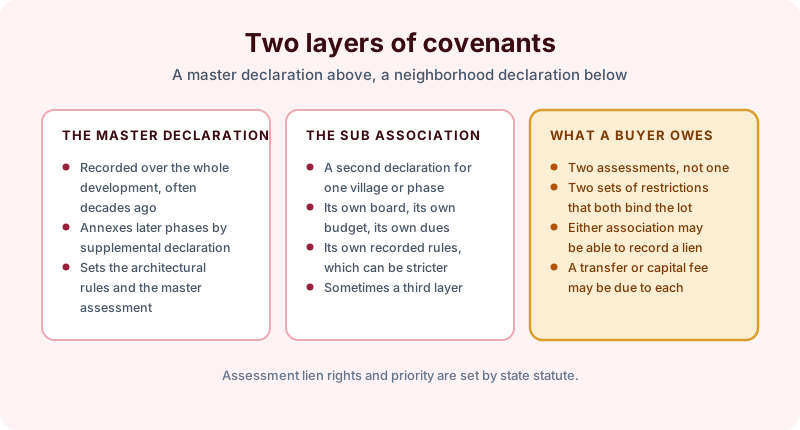
The master declaration
Recorded over the entire development, frequently decades before the house was built, and amended many times since. It sets the architectural standards, the common area arrangements and the master assessment. Later phases get pulled in by supplemental declaration as the developer builds them, which means the document that actually brings your lot under the master may have recorded years after the original.
The sub-association
A second declaration covering one neighborhood inside the project, with its own board, its own budget and its own dues. Its recorded rules can be stricter than the master’s — a paint palette, a fence standard, a short-term rental ban that the master never imposed. In the largest developments there is occasionally a third layer on top of that.
What the buyer is actually taking on
- Two assessments. Not one, and they are billed separately.
- Two sets of restrictions. Both bind the lot, and the stricter one governs in practice.
- Two possible lienholders. Either association may be able to record an assessment lien, and whether it takes priority over a mortgage is a question of state statute rather than of the declaration.
- Transfer and capital contribution fees. Each association may charge one at closing.
That lien question is the same one our guide to HOA liens and your title search works through, with the complication that here there are two parties who can file.
Why the second one is easy to miss
Nothing on the deed names either association. The deed says the lot is conveyed subject to covenants of record and gives a book and page, usually for the master declaration alone, because that is the one that was already recorded when the subdivision plat went in. The sub-association declaration recorded later, against a smaller set of lots, and it is found by searching the parcel forward rather than by reading the deed. A listing agent describing the dues as one figure is often describing one association.
What a search returns
We pull the declarations and the amendments found of record, including supplemental declarations annexing the phase, plus any assessment liens recorded against the lot. What the search does not do is tell you the current balance owed, which comes from the associations themselves in an estoppel or resale certificate. It also does not interpret the covenants, which is work for an attorney. Recording practice varies by county, and a clean search is not proof that no charge exists.
When in doubt
Ask the seller for the name of every association the lot belongs to, then check it against what the record shows, because owners routinely know about one and not the other. Order online, or ask us to scope the search before anything is ordered. Our products page sets out the search terms available.