

· AFX Research
Title Search for a Property Bought at a Partition Sale
A partition sale ends a co-ownership dispute by court order, and the deed you receive carries no warranty. Here is what the land record holds, what stays in the court file, and what to confirm before closing.
Table of Contents
When co-owners cannot agree, a court can order the land sold and the money divided. The deed that comes out of a partition sale is only as good as the case behind it, and most of that case is in a court file rather than in the land records.
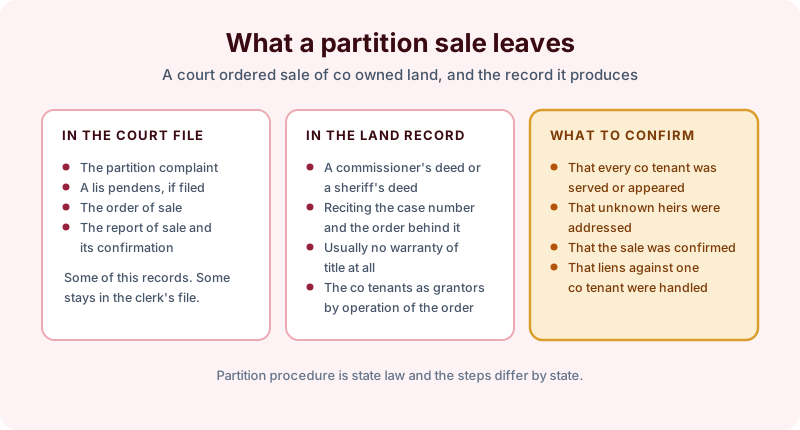
What the court file holds
The complaint, any lis pendens that was filed, the order of sale, and the report of sale with its confirmation. Some of that records in the land records and some of it never leaves the clerk’s office — which is exactly why a search that reads only the recorder’s index can look thinner than the transaction actually was.
What the land record holds
A commissioner’s deed or a sheriff’s deed, depending on the state, reciting the case number and the order behind it. These deeds almost never carry a warranty of title. The co-owners appear as grantors by operation of the order rather than because any of them signed anything, which is a meaningful difference if one of them later says they were never properly brought into the case.
What is worth confirming
- Service. Every co-tenant had to be served or appear. A partition that missed one leaves that person’s undivided interest outstanding.
- Unknown heirs. Inherited property is the usual reason a partition happens at all, so the case often had to deal with heirs nobody could name. How that was handled matters.
- Confirmation. An order authorizing a sale is not the same document as an order confirming one took place. Both should be there, and the dates should make sense against the deed.
- Liens against one owner. A judgment against a single co-tenant attaches to that person’s share, and whether the sale cleared it or merely moved it to the proceeds is a state law question.
The shape of the problem is close to the one in our guide to a title search when you inherit a house with siblings, because the two frequently involve the same family and the same parcel a few years apart.
What a search can and cannot do
We report what was found of record, including the deed, the recorded case filings, and every lien and encumbrance found in the term searched. Where a lis pendens was recorded, we report whether anything later released it. We cannot tell you whether service was good or whether the order was correctly entered — those are legal conclusions, and they belong to an attorney in that state. Recording practice varies by county, and an empty result does not prove nothing exists.
The bottom line
A partition deed is a real conveyance, but it arrives without the warranty you would get in an ordinary sale, so the confirmation work is yours to do. Pull the deed, read the recitals, and have someone check the case. Order online, or ask us what a search of that property would and would not cover first.