

· AFX Research
Title Search for a Property Sold by a Receiver
A receiver's deed comes from a court order rather than from a willing owner, so the authority behind it sits in a case file instead of the land records. What to check before buying, and what a search can confirm.
Table of Contents
A receiver is someone a court appoints to take control of property while a lawsuit runs — a foreclosure, a partnership breakup, a fraud case, a dispute between owners who cannot agree on anything. Sometimes the receiver is authorized to sell. The deed you receive is only as good as the order standing behind it, and that order is not in the land records.
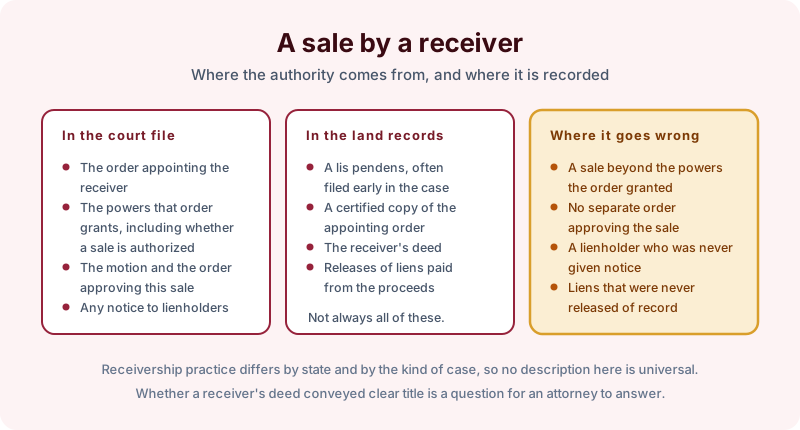
Where the authority lives
The appointing order is the foundation document. It names the receiver and sets out exactly what that person may do, and the power to sell real estate is not automatic — plenty of receivers are appointed only to collect rents and preserve the property.
Most courts then require a second step for a sale, with a motion, notice to interested parties, and an order approving the specific transaction. Those filings sit in the case file at the courthouse, which is a different place from the recorder’s office and a different search.
What reaches the land records
Usually a lis pendens filed early in the case, a certified copy of the appointing order, the receiver’s deed itself, and releases of any liens that were paid from the sale proceeds. Not always all of them, and the gaps are where the trouble starts. A lis pendens left on file after the case ended is a common loose end, and it behaves the way our note on lis pendens describes.
Where these sales go wrong
Four failures account for most of the later problems. A sale that went beyond the powers the order actually granted. No separate order approving this particular sale. A lienholder who was never given notice and whose lien therefore survives. Liens that were paid at closing but never released of record.
The last one is the most common by a wide margin, and it is the easiest to catch before closing rather than two years later when you try to sell.
What a title search covers
We report the recorded instruments — the lis pendens, the certified order if it was recorded, the receiver’s deed, and the status of every lien and judgment we find against the property and the names searched. Copies are attached, and the open items are listed plainly rather than summarized away.
Reading the court file itself is separate work, and on a receivership purchase it is worth doing. A search reports what was found of record, which is never the same as proving that nothing else exists.
When in doubt
Receivership practice differs by state and by the kind of case, so no general description covers every court. Whether a receiver’s deed actually conveyed clear title is a legal question for an attorney, not something a records search decides. Order online to get the recorded picture first, or ask us what a search of that property would and would not cover before you commit.