

· AFX Research
Title Search for a Property Under a Conservation Easement
A conservation easement is a permanent recorded restriction held by a land trust or an agency, limiting building and subdivision for every future owner. Here is what a title search shows, and what to read before you buy.
Table of Contents
Acreage priced below the comparables is sometimes a bargain and sometimes a restriction. A conservation easement does not transfer ownership, it permanently limits what an owner may do — and it was almost certainly granted by somebody who sold the property years before you looked at it. The restriction stays with the land, so a title search is where you find out it exists.
Who holds it, and why it was granted
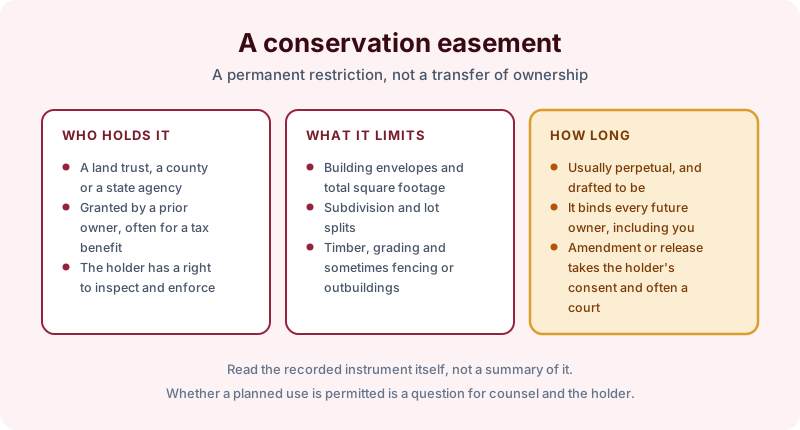
The holder is typically a land trust, a county, or a state agency. A prior owner granted it, often in exchange for a federal income tax deduction or a property tax reduction, and the holder retains a right to inspect the property and to enforce the terms. That inspection right is itself an easement, and it continues regardless of who owns the land.
What it actually restricts
Terms vary enormously between instruments, which is why reading the recorded document matters more here than almost anywhere else. Common restrictions limit the building envelope and total square footage, bar subdivision or further lot splits, and govern timber harvest, grading, fencing, and outbuildings. Some permit one additional residence for a family member; many do not. Some allow agriculture and prohibit commercial recreation.
A summary in a listing or a tax record is not a substitute for the instrument. Two neighboring parcels under easements from the same land trust can carry materially different terms, because each was negotiated against the conservation values a particular property happened to have.
The baseline documentation report is worth asking about as well. It records the condition of the property on the day the easement was granted, and it is the yardstick the holder measures later changes against. It is usually referenced in the recorded instrument rather than recorded alongside it, so getting a copy means asking the holder.
How long it lasts
Almost always perpetual, and drafted deliberately so. Amendment or release requires the holder’s consent, and in many states a court proceeding as well, because the public received a tax benefit in exchange for the restriction. Treating an easement as negotiable is usually a mistake.
What the search returns
The search reports the recorded conservation easement, any amendments, baseline documentation references, and the related access or monitoring rights found of record against the parcel, with copies. It does not interpret the terms, it does not say whether your intended use is permitted, and recording practice varies by county. An empty result means nothing was found of record rather than that no restriction exists.
Where a parcel also carries deed restrictions, the two sets of limits stack, and the stricter one governs in practice.
The takeaway
Order the search before the inspection period closes, get the instrument itself, and read the permitted-uses section against what you actually plan to do. If anything is ambiguous, the holder will usually tell you how they read it, and an attorney in that state can tell you whether that reading binds them.
Order online, or ask us what a search of that acreage would cover before anything is ordered.