

· AFX Research
Deed Restrictions and Your Title Search
Recorded restrictions control what you can build, park, run, and rent, and they bind your lot whether or not your deed repeats them or an association exists to enforce them. What the record shows, and what it cannot resolve.
Table of Contents
Liens cost money and go away when paid. Restrictions do neither. A recorded covenant limits what you may do with the property, it binds your lot without appearing in your own deed, and no payment removes it — which is why the search should turn them up before a buyer has plans, not after.
Where they come from
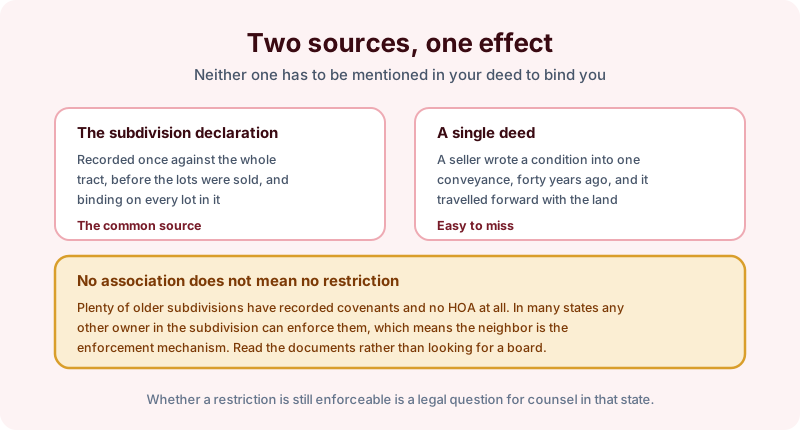
Two sources account for nearly all of them. A subdivision declaration was recorded once against the whole tract before any lot was sold, and it binds every lot created out of it. A single deed in the chain carried a condition a seller wrote in decades ago, and it travelled forward with the land.
The second kind is the one people miss, because nothing in the recent chain repeats it. Only reading back through the conveyances finds it.
What they typically control
Use is the big one: residential only, no commercial activity, no short-term rental. Then the physical items — setbacks, height, minimum square footage, exterior materials, fences, outbuildings — and the ones that generate the most disputes, covering parked vehicles, boats, RVs, and livestock.
Restrictions frequently sit alongside recorded easements, and a report will list both, which our note on easements and your title search covers separately.
Who can enforce them
Not just an association. Plenty of older subdivisions have recorded covenants and no HOA at all, and in many states any other owner in the subdivision can enforce them. That makes a neighbor the enforcement mechanism, which is both less predictable and harder to negotiate with than a board. Where an association does exist, its assessment powers are a separate matter, addressed in HOA liens and your title search.
How long they last
It varies more than buyers expect. Some declarations state a term with automatic renewal periods, some are written to run indefinitely, and some are subject to state marketable title acts that can cut off old restrictions after a period unless re-recorded. Whether a particular restriction is still enforceable, and against whom, is a legal question for counsel rather than a records finding.
Two practical points. Long-standing violations do not necessarily cure a restriction, and they do not necessarily leave it enforceable either. And a restriction that everyone in the neighborhood ignores is still on the record, which is where it will surface — at the next sale, as it does with the improvements in unpermitted additions and your title search.
The old covenants you may see
Chains of title from the first half of the twentieth century sometimes contain racially restrictive covenants. These are void and unenforceable, and they appear in the record because the record is historical. Many states now provide a procedure to have such language struck or redacted from the recorded instrument, which is a matter for counsel and the recorder rather than something a search resolves. When we find one, we report the document as it exists.
The bottom line
Order the search before making plans for the property, and ask for copies of the declaration and any restrictive covenants rather than a summary line — the operative wording is what decides whether a plan works. Order online, or ask us to pull the subdivision declaration along with the chain.