

· AFX Research
Title Search for a Property With a Billboard Lease
A billboard on the corner reads as free income until you look at the paperwork. Here is what the recorded memorandum shows, why the structure is so hard to remove, and what you have to ask the seller for.
Table of Contents
A lot with a billboard on it comes with a check every month and a story about how the sign pays the property taxes. Both can be true. What the buyer rarely learns before closing is that the agreement behind the sign may outlast their ownership of the property, and that it can quietly limit what gets built on the rest of the lot.
What actually reaches the record
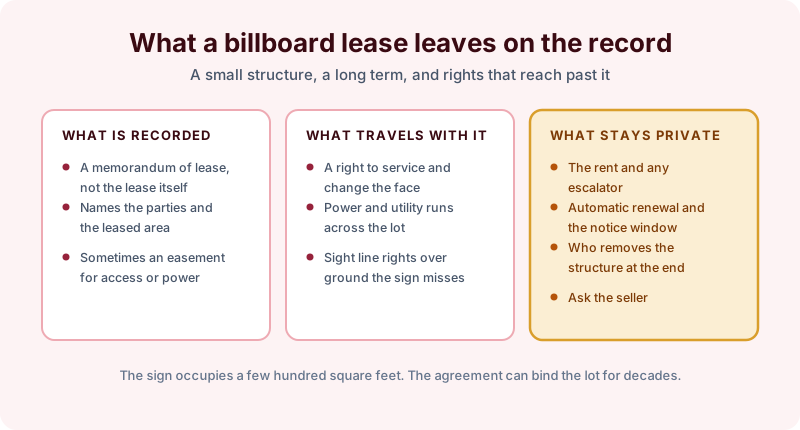
The lease itself is almost never recorded. What gets filed is a memorandum of lease, a short instrument naming the parties, the leased area, and the term, with the commercial terms deliberately left out. Alongside it you may find an easement for access, for power, or both.
Terms run long. Twenty years is common, and once renewal options are counted many of these stretch past thirty. The leased ground is tiny — a few hundred square feet at most — so the structure takes up almost nothing and the agreement binds almost everything.
The rights that reach beyond the sign
Three clauses matter more than the rent.
- Access. The operator can come onto the property to service the structure and change the face, usually at any hour, which means a right of way across whatever sits between the road and the sign.
- Utilities. Power runs to the sign, often across ground the owner expected to use for something else.
- Sight lines. This is the one that surprises people. Many of these agreements bar the owner from putting up anything that blocks the view of the sign, which can cap building height or dictate where a structure may sit. That is a restriction on the whole lot, not a term about advertising, and it behaves much like a deed restriction.
Why it is so hard to end
New sign permits are tightly restricted almost everywhere, and many existing structures are legally nonconforming — they can stay, but they could not be rebuilt. That scarcity is where the value sits, and it is why operators defend these locations hard.
Most agreements also renew automatically unless notice is given well before the term ends, and the notice window can be a year or more. Owners who intend to be rid of a sign routinely discover they missed the only chance to say so.
What to do before you close
Order a search that covers the parcel and attach the recorded memorandum, any easement filed with it, and every assignment — these leases get sold between operators, so the entity that signed in 1999 is rarely the one you would negotiate with now. Check whether the memorandum predates the mortgage, because that ordering decides what survives a foreclosure, in the same way it does for other recorded leases.
Then ask the seller for the lease itself. The rent, the remaining term, the renewal window, whether the operator may assign it, and who is responsible for removing the structure are all in a document the county never received.
The bottom line
Price a billboard as a long encumbrance that happens to pay rent. Order online and we will run the parcel and attach every recorded instrument we find, or ask us what a search of that scope would cover before you order.