

· AFX Research
Title Search for a Property With a Party Wall
A wall two owners share sits on a boundary that runs straight through it. What the recorded agreement should settle, what the common law fills in when none exists, and why a row house usually has nothing on file.
Table of Contents
Row houses, attached commercial buildings and many townhouses share a structural wall sitting on the property line. Each owner typically holds to the center of it, with cross easements for support in both directions, and the arrangement works perfectly until somebody wants to renovate, rebuild or demolish.
How it is actually held
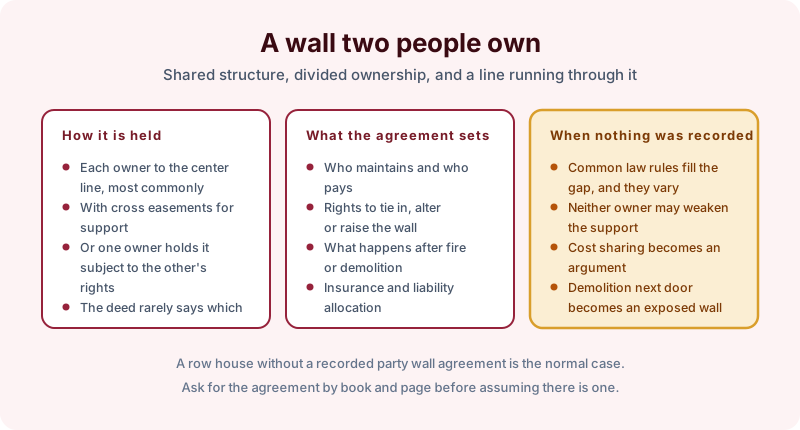
Three structures appear. Each owner to the center line with mutual support easements, which is the most common. One owner holding the entire wall subject to the neighbor’s rights of support and use. Or, in a planned community, the wall defined as a common element in a recorded declaration.
The deed usually does not say which. On older attached housing the arrangement predates the current owners by a century and nobody has had reason to look.
What a recorded agreement settles
Four things, and the absence of each one causes a predictable argument. Who maintains the wall and how the cost is split. Rights to tie into it, alter it or build higher. What happens after a fire or a demolition on one side. How insurance and liability are allocated.
Where an agreement exists it is recorded and a search finds it. Where one does not, common law rules fill the gap, they vary by state, and they are considerably less specific than anybody would like.
When nothing was recorded
This is the normal case on older row housing, not the exception.
The settled parts are narrow. Neither owner may weaken the support the other depends on. Neither may remove the wall unilaterally. Beyond that, cost sharing becomes a negotiation, and the most consequential scenario is a demolition next door that leaves your wall exposed to weather for the first time in a hundred years.
That exposure is a real one and it is not a title defect. The search establishes whether an agreement exists and what the chain says about the wall, and it establishes nothing about the structure’s condition.
What else to look for
Encroachments, which on attached buildings are routine. A chimney, a parapet, a footing or a cornice crossing the line is common, usually tolerated, and occasionally recorded as an encroachment agreement. Where one exists it binds; where it does not, the position is less settled than the neighbors assume. That is the same analysis as in unpermitted additions and your title search.
What to order
A full chain search on both the subject property and, where possible, the adjoining parcel, because a party wall agreement may have been recorded against one and not indexed usefully against the other. Ask specifically for any party wall agreement, encroachment agreement or recorded declaration.
A records search reports what was recorded and indexed as of the day it was run. It does not establish where the wall physically sits, which is a survey, or whether it is sound, which is an inspection.
The bottom line
Ask for the party wall agreement by book and page rather than for reassurance that one exists. Compare the available searches and order online, or ask us how to scope an attached property.