

· AFX Research
Title Search for a Property With a Private Transfer Fee
A private transfer fee covenant takes a cut of every future sale price, it runs with the land, and almost nothing about the house tells you it exists. Here is where it hides in the record and what a search can establish about it.
Table of Contents
A private transfer fee covenant is the only encumbrance most buyers have never heard of that will cost them money at a sale they have not scheduled yet. It does not affect use, it does not affect financing payments, and nothing about the property reveals it. It sits in a recorded document and it takes a percentage of the price every time the house changes hands.
What the covenant actually does
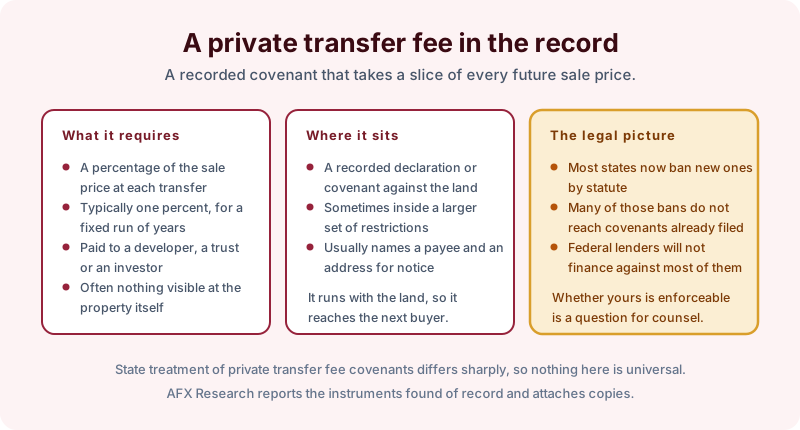
The usual form takes one percent of the gross sale price at every transfer for a fixed run of years, often ninety-nine. The money goes to a developer, a trust set up for the purpose, or an investor who bought the income stream from the original filer. The covenant is drafted to run with the land, which means it reaches you as a buyer and it reaches whoever buys from you.
These were marketed heavily to developers in the 2000s as a way to monetize a subdivision long after the last lot sold. Many of them are still on title.
Where it hides
It is recorded, which is the good news. Sometimes it stands alone as a declaration of covenant. More often it is a clause inside a larger set of restrictions filed when the subdivision was created, which is why it behaves so much like the problems in deed restrictions and your title search — easy to find if you read the documents, invisible if you only read a summary.
A current owner search picks up what is recorded against the parcel today. A covenant filed twenty years ago by a developer who no longer exists is still recorded against the parcel today, so it comes back. What will not come back is a fee somebody agreed to in a side contract that was never recorded, because an unrecorded agreement is not in the record to find.
The legal picture, which is genuinely messy
Most states have now banned new private transfer fee covenants by statute. A great many of those bans do not reach covenants recorded before the ban took effect, and the drafting varies. Fannie Mae and Freddie Mac will not buy loans secured by most properties carrying one, which means a buyer may simply be unable to get conventional financing.
Whether a particular covenant is enforceable, and whether it survived a state statute, is a legal question for an attorney licensed where the property sits. We report what is recorded and attach the instrument. Treating that attachment as an opinion would not be doing you a favor.
The bottom line
If a property is in a subdivision built after about 2000, ask for the full set of recorded covenants rather than a summary of them, and read the resale clauses. The cost of finding this at closing is far higher than the cost of finding it now. Order online and we will pull the recorded restrictions along with the chain, or ask us what a search of that scope would cover first.