

· AFX Research
What a Title Search Cannot Find
The honest version: a search reports what was recorded in the county searched as of the day it ran. Here are the four categories of claim that fall outside that, and what covers them instead.
Table of Contents
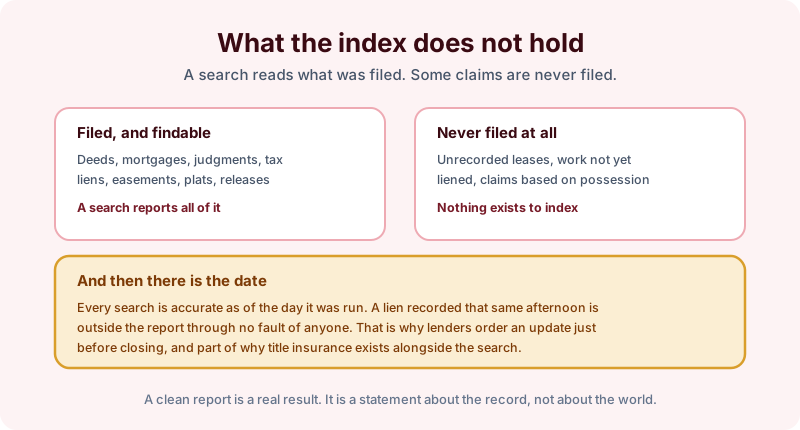
We would rather tell you this before you order than after you read the report. A title search is a search of the record, which means its power and its limits come from the same place. Everything filed in the county is findable. Anything that was never filed is not, and no amount of thoroughness changes that.
Claims nobody has filed yet
The clearest example is construction. A contractor finished work last month and has not recorded a lien. In many states the right to file relates back to when the work began, so a lien recorded next week can take priority ahead of your closing. There was nothing in the index to find, and the exposure was real the whole time.
Unpaid HOA dues behave similarly until an assessment lien is recorded, and so do unpaid utility or municipal charges in the counties that record them at all. The association knows the balance; the recorder does not, which is why an estoppel letter is worth asking for alongside a search.
Rights that come from conduct
Some interests arise from use rather than from paperwork. A neighbor who has crossed a strip of land for decades may have a claim, and someone occupying land openly for a statutory period may have another. Whether either exists is a legal question, and neither necessarily produces a recorded document.
The same goes for a boundary encroachment. A search reports the recorded legal description and any recorded easement; it does not tell you where the fence stands. That is a surveyor’s work, and the two documents answer different halves of a boundary question.
Off-record ownership problems
An unrecorded deed sitting in a drawer, a forged signature, an heir nobody knew about, a deed delivered but never filed. These are the classic hidden defects, and they are precisely what a title insurance policy is built to address, because they are undiscoverable by definition rather than by oversight. A search can still narrow the field: it establishes who holds record title and how, which is where any ownership dispute has to start. Our comparison of a search and a policy covers where each one fits.
The gap after the search date
Every report carries a date, and it is accurate as of that date. A lien recorded the same afternoon is outside it. This is not sloppiness, it is arithmetic, and it is why lenders order an update immediately before closing rather than relying on a search from three weeks earlier.
The bottom line
Read a clean report as what it is: a solid statement about the record in the county searched on the day it ran, with copies to prove it. That answers most questions people actually have, and it pairs with a survey, a policy, and a pre-closing update for the rest. Order online, or ask us what your situation needs and we will tell you plainly what a search would and would not cover. Our products list the available depths.