

· AFX Research
Boundary Line Agreements and Your Title Search
Two neighbors settle a disputed line, record the agreement, and leave their deed descriptions exactly as they were. A title search finds both documents, and a buyer has to understand why they disagree.
Table of Contents
A fence has been in the wrong place since 1972. A survey finally says so, and rather than sue each other, the two owners sign an agreement fixing the line where the fence has always been and record it. That recorded agreement is now part of the title record for both parcels — and it will often sit there contradicting the legal description in each deed.
Why neighbors sign one
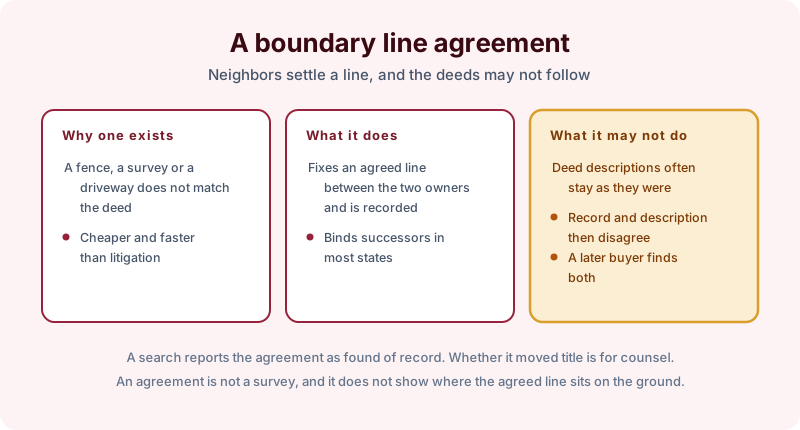
Boundary uncertainty is common and expensive to litigate. A fence that does not follow the deed, a driveway that crosses a line, a survey that disagrees with the one done thirty years earlier, an ambiguous call in an old description. A boundary line agreement resolves it by consent, usually for the cost of a survey and a few hours of a lawyer’s time.
In most states a recorded agreement of this kind binds not only the two signers but their successors, which is the entire point of recording it. A few states treat the agreement as moving title outright, and others treat it as resolving an uncertainty that was always there, which can matter for taxes and for how a lender reads the file.
What it does not do
It generally does not rewrite the deeds. The agreement describes the agreed line, gets recorded, and the underlying legal descriptions stay exactly as they were. Some careful transactions follow up with exchange deeds or corrective deeds that bring the descriptions into line. Many do not.
The practical result is a record where two documents say different things about the same boundary. A search reports both, with copies, and that is the right outcome. Deciding which one controls is a legal question that depends on state law, on the form of the agreement, and sometimes on how long the agreed line has been observed.
What to do when a search turns one up
Read the agreement itself rather than the index entry, because the useful detail is in the description and the recitals. Check whether a survey was attached. Check whether any later deed used the new line or kept the old one. An agreement recorded against one parcel but indexed under only one of the two owners is easy to miss from the other side of the line. And remember that a title search is not a survey and does not show you property lines on the ground — it reports instruments, and locating the line is a surveyor’s job.
Where the two descriptions genuinely conflict, that is a question for an attorney and often for a new survey before closing, not something to resolve by choosing the more recent document. Our note on legal descriptions versus property addresses covers why the description is the part that matters.
When in doubt
If the parcel has a fence line, a hedge or a driveway that does not look like the plat, assume there may be something recorded about it and search far enough back to find it. Order online, or ask us what term would reach an agreement from the era you are worried about.