

· AFX Research
Title Search for a Property With an Affidavit of Heirship
An affidavit of heirship bridges a chain when an owner died without probate, but it is sworn testimony rather than a court finding. What the document states, how much weight it carries, and the risk it leaves behind.
Table of Contents
When an owner dies and nobody opens a probate, the deed stays in the dead person’s name and the family still needs to sell. In several states the usual fix is an affidavit of heirship, a sworn statement naming the heirs, recorded in the land records so that a deed from those heirs has something to stand on. It closes the gap in the index without ever closing the question of who the heirs are.
What the document says
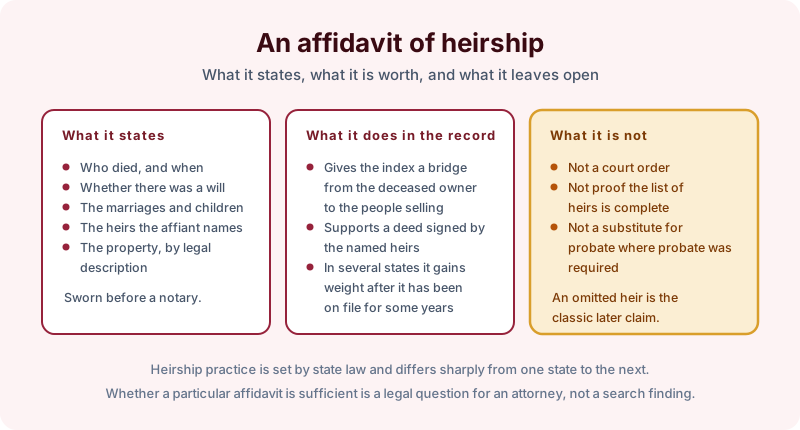
An affidavit of heirship identifies the person who died and the date of death, states whether there was a will, sets out the marriages and children, names the people the affiant believes are the heirs, and describes the property. It is sworn before a notary, usually by someone who knew the family but has no financial stake in the outcome — a neighbor, a longtime friend, an in-law.
What it does in the record
Its job is to connect a deceased owner to the people signing the next deed. Without it, the chain simply stops, and a buyer is left with a deed from grantors whose connection to the record owner is nowhere stated. With it, the index has a bridge.
Several states give these affidavits added weight once they have been on file for a period of years, treating them as prima facie evidence of the facts recited. That does not make them conclusive, and the length of time and the effect differ by state.
What it is not
It is not a court order. It is not proof that the list of heirs is complete, and it does not substitute for probate where probate was actually required. The classic problem is the omitted heir — a child from an earlier marriage, an heir nobody mentioned — who surfaces later holding an undivided interest that the deed never conveyed.
That risk is the reason a buyer treats this differently from the ordinary inherited property situation where an estate was properly administered.
What a title search shows
We report the affidavit with its recording date, book and page, the deed that followed it, and the names of everyone who signed, with copies attached. We also search those names for liens and judgments, because an heir’s own creditors can reach the undivided interest that heir received at the moment of death.
What we cannot do is confirm that the affidavit is accurate or that the heirs are all accounted for. That is a legal conclusion, and it belongs to an attorney in that state. A search reports what was found of record and never proves that nothing else exists, the same limit set out in what a title search cannot find.
The bottom line
Heirship practice is set by state law and differs sharply between states, so an affidavit that is routine in one place may carry little weight in another. If one sits in your chain, get it read by counsel before closing rather than afterward. Order online and we will pull the affidavit, the deed and the name searches together, or ask us what a search of that chain would and would not cover first.