

· AFX Research
Title Search for an Assumable Mortgage Purchase
Taking over a seller's low rate loan leaves the existing mortgage on the property rather than paying it off. Everything recorded behind that mortgage is still there on closing day.
Table of Contents
Assumptions came back into fashion for an obvious reason. A seller holding a government backed loan at three percent has something genuinely valuable, and a buyer who can take it over saves a great deal of money over the life of the loan.
The title work changes shape when you do. In a normal purchase the existing mortgage gets paid off and released at closing, and the search is partly a map of what needs clearing. In an assumption the first mortgage stays exactly where it is, and the search becomes a question about everything sitting behind it.
What the record shows about the loan
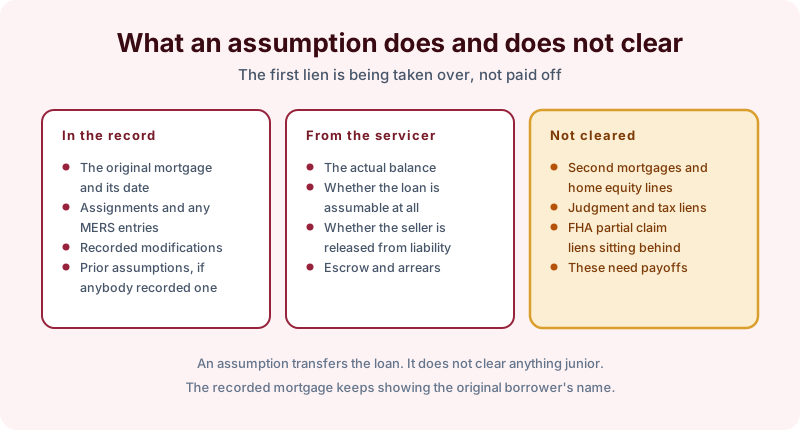
The search returns the original mortgage with its recording date, the assignment chain behind it including any MERS entries, and any recorded modification. That matters more here than usual, because the instrument you are taking over is the one in the record, with whatever has been done to it along the way.
A recorded modification from a forbearance or workout can change terms substantially, and the buyer inherits the modified version.
What only the servicer can tell you
The record does not show a balance. It does not show whether the loan is current, what is in escrow, or whether any arrears have been capitalized.
It also does not show whether the lender will approve the assumption or release the seller from liability. Those are two separate approvals and buyers regularly assume the first one carries the second. For the seller in particular, an assumption without a release leaves them on the note.
The liens that do not go away
This is where assumptions catch people. Paying off a first mortgage at closing forces every junior lienholder to the table. Assuming it does not.
A second mortgage, a home equity line, a judgment lien or a tax lien recorded against the seller stays attached to the property unless it is separately paid and released. The same applies to an FHA partial claim, which is a real recorded second lien that many borrowers do not think of as a loan at all. The ordinary approach in how to check if a mortgage was paid off applies to each of them.
Prior assumptions are worth looking for too. Where an earlier one was never recorded, the mortgage of record still names a borrower who sold the house years ago, which is one of the chain problems covered in errors found in a title search.
Which loans can be assumed
FHA, VA and USDA loans are generally assumable with the lender’s approval. Conventional loans usually are not, because the due on sale clause lets the lender call the balance when the property transfers.
Federal law does block enforcement of that clause for certain transfers within a family. Those are not assumptions in the marketed sense, but the result is the same, which is a loan surviving a change of owner.
What to send us
The address, county and parcel number, the seller’s full name with any former names, and the name of the current servicer. Say that the transaction is an assumption, because it changes what we flag.
The bottom line
An assumption moves one loan and clears nothing else. Get the junior liens identified early enough to negotiate payoffs, and get the release of liability in writing. Order a search or tell us the address.