

· AFX Research
What Happens When a Deed Was Never Recorded
A signed deed that never reached the county is a transfer the public record knows nothing about. Why liens keep attaching to the old owner's name, and what a title search will and will not show.
Table of Contents
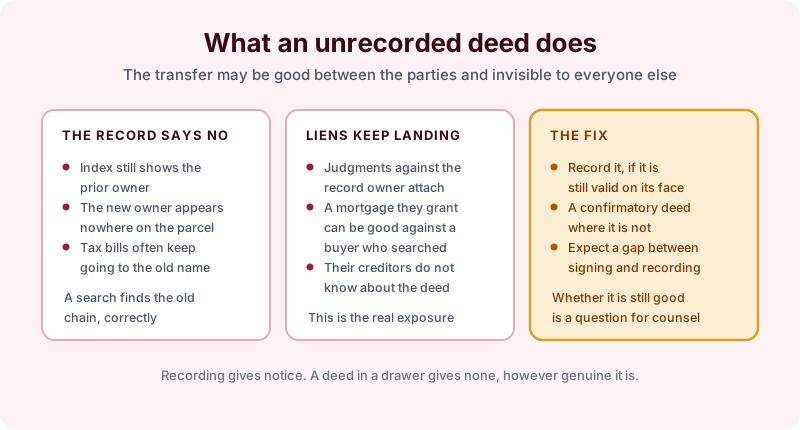
A deed does not have to be recorded to transfer property between the people who signed it. It does have to be recorded to tell anybody else that the transfer happened, and that gap is where the trouble lives. An unrecorded deed is valid between the parties and invisible to everyone searching the parcel.
How it happens
Most unrecorded deeds are not schemes. A family member signs a deed and puts it in a safe deposit box for later. A for-sale-by-owner closing skips the recording step after everyone shakes hands. A deed into a trust gets prepared by an estate planner and never leaves the binder. A seller holds a signed deed as security in an owner-financed deal.
In each case somebody believes the property changed hands, and the county’s index disagrees.
What the record shows instead
A title search reports what was recorded. If no deed was ever filed, the search returns the last recorded owner — correctly — and shows no sign of the later transfer. Tax bills usually keep going to the same name, and so do assessment notices.
That is not an error in the search. It is the record doing exactly what it is designed to do, which is what how to find out who owns a property walks through in more detail.
Why liens keep attaching
This is the part that costs money. Judgments docketed against the record owner attach to real property in their name, and as far as the court and the creditor are concerned, that includes this parcel. A mortgage the record owner grants can be good against a later buyer who searched and found nothing. A tax lien, a mechanics lien and an HOA lien all land the same way.
Nobody filing against that name is doing anything wrong. They searched, they found the owner the record names, and they relied on it. That reliance is the whole point of a recording system.
Recording it later
A deed can usually be recorded long after it was signed, provided it is still valid on its face — correct names, a legal description, the required signatures and acknowledgment. Many are not, especially older ones, and a confirmatory or corrective deed from the original grantor is the common repair, as corrective deeds and scriveners errors describes.
Two complications come up often. If the grantor has since died, lost capacity or dissolved, getting a new signature is a probate or entity problem rather than a paperwork one. And anything recorded during the gap is already in the chain and does not disappear when the old deed finally appears.
Whether a late-recorded deed defeats an intervening lien is a legal question that turns on your state’s recording act and on who knew what. That belongs to an attorney, not to a search.
The takeaway
If you are holding a deed that was never filed, treat it as urgent rather than tidy-up work. Order a search first so you know what has been recorded against the property in the meantime, then take the deed and the search to counsel. A search tells you what is on record and what is not; it cannot tell you that nothing exists, and it does not resolve priority. Order online, or ask us what a search of that parcel would cover before you spend anything.