

· AFX Research
Title Search When Buying From Family
Buying a house from a parent or a sibling removes most of the people who would normally insist on a title search. The liens and unrecorded interests arrive anyway, and they attach to the property rather than the relationship.
Table of Contents
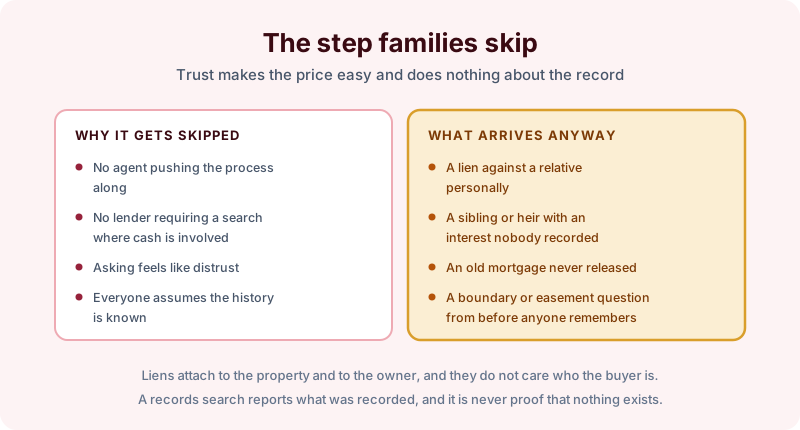
Family sales skip the machinery. There is usually no agent, often no lender, sometimes no attorney, and asking for a title search can feel like accusing someone of hiding something. The problem is that liens attach to the property and to the owner, and they are entirely indifferent to how well the parties know each other.
What tends to be sitting there
Four findings come up repeatedly on family transfers.
- A lien against the relative personally. A judgment, a tax lien, or a medical debt reduced to judgment attaches to real property they own. It does not disappear because the buyer is their child.
- Another heir with an interest. Where the property came through an estate and the paperwork was never completed, a sibling, a half sibling, or a child of a deceased sibling may hold a share nobody has thought about. This is the most common serious problem in family sales, and it is the same territory as a title search on inherited property.
- An old mortgage never released. Paid off in 1998 and still on the record because the satisfaction was never filed.
- A boundary or easement question from long before anyone currently involved was paying attention.
Nobody is going to require it
On an ordinary purchase a lender demands a search, and on a cash family sale nobody does. The paperwork is often a quitclaim deed drafted from a template, which conveys whatever the relative happens to own and promises nothing about what that is. Our note on what a quitclaim deed means for your title search sets out how little it guarantees.
That combination, no lender and a deed with no warranties, is precisely why these transfers produce problems that surface years later when the buyer tries to sell or refinance.
How to raise it without friction
Frame it as protecting both sides, because it does. A seller who believes the title is clean has nothing to lose from confirming it, and a great deal to lose from a dispute with a family member two years after the money moved. If an heir’s interest turns up, everybody would rather know now, while the person who can sign a deed is available and willing.
It is also cheap relative to the transaction, and it is the one step that cannot be redone afterwards on the same terms.
If a problem surfaces
Most are fixable. A missing satisfaction can be chased, a judgment can be paid or negotiated, and an unrecorded heir’s interest can often be resolved with a deed if everyone is cooperative. All of that is far easier before closing than after, and considerably easier while relations are good. Where the issue is genuinely tangled, that is a question for an attorney rather than a search.
The bottom line
The search is not a comment on your family. It is a check on a property that has a recorded history nobody in the room has actually read. Recording practice varies by county, and an empty result means nothing was found in the indexes searched rather than that nothing exists. Order online for a certified search of the parcel and the seller’s name, or ask us what a search of that scope would cover first.