

· AFX Research
Title Search When the Selling Company Was Dissolved
A company can be closed by the state and still appear on the deed as the owner. What dissolution does to signing authority, which records answer the question, and why the county file is only half of it.
Table of Contents
A deed arrives signed by the manager of an LLC that the secretary of state closed in 2019 for an unfiled annual report. The county will record that deed, because the recorder checks the form of a document and not the standing of the company that signed it. Whether it conveyed anything is a different question, and it tends to surface years later when the next buyer orders a search.
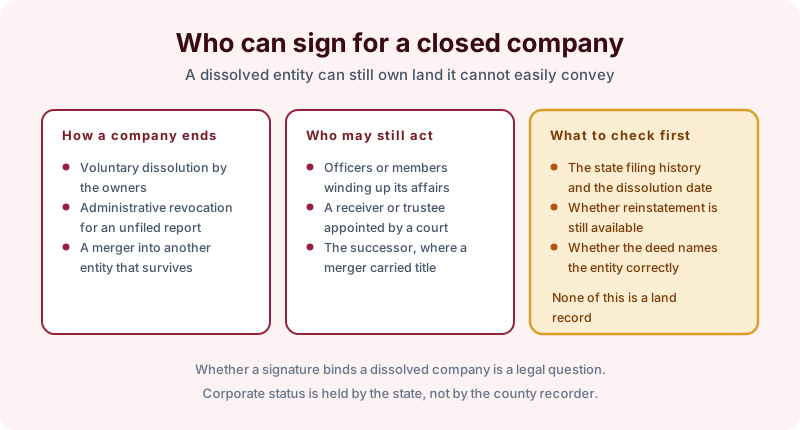
Three ways a company ends
Voluntary dissolution is the orderly one. The owners file, the entity winds up, and somebody is authorized to sign the deeds that close it out.
Administrative dissolution or revocation is the common one. A report goes unfiled or a fee goes unpaid, the state closes the entity, and frequently nobody at the company notices for years. Business carries on, invoices go out, and property stays titled in the name.
A merger is the third. The company disappears into a survivor that holds its assets, which means the land has a new owner even though no deed was ever recorded.
Who can still sign
In most states dissolution does not strip a company of its property. It limits what the company may do to winding up its affairs, and selling real estate to pay creditors or distribute to owners usually fits inside that. Officers or members may still have authority, a court appointed receiver may have it instead, and in a merger it belongs to the survivor. Many states also allow reinstatement, which can cure the gap retroactively.
None of that is decided by the county record. The recorder holds the deed. The state holds the filing history, the dissolution date, the reinstatement rules and the name of whoever was authorized to act.
What the search contributes
A search gives you the chain as it stands, including the deed into the company, the deed out, and anything recorded against the entity in between. It will show a mismatch between the name on the deed in and the name on the deed out, which is how most merger and name change problems are caught. Our note on name variations covers why that comparison is worth doing carefully, and property owned by an LLC or trust covers the ordinary case.
Why it usually surfaces late
Nothing stops the next closing. The deed records, the buyer gets a policy or does not, and the chain looks ordinary in the index because the index shows names and dates rather than corporate standing. The question only gets asked when somebody runs a full chain of title rather than a current owner search, which is one of the practical differences described in our note on a current owner search versus a full chain.
By then the fix is harder. The signers may have scattered, the reinstatement window may have closed, and curing the gap can mean a corrective deed, a reinstatement, or a quiet title action.
The bottom line
Run the search and pull the state filing history together, because neither answers the question alone. If the deed out was signed after the company closed, that is a cure item for an attorney rather than a defect you can read past. Recording practice and dissolution law both vary by state, and a recorded deed is proof it was recorded and nothing more. Order online, or ask us what the search would cover before anything is ordered.