

· AFX Research
Judgment Liens and Your Title Search: What Shows Up
A judgment against an owner can attach to their house, but only after someone records it in that county. Here is how a judgment becomes a lien, where it appears in a search, and why a name match is not the end of the inquiry.
Table of Contents
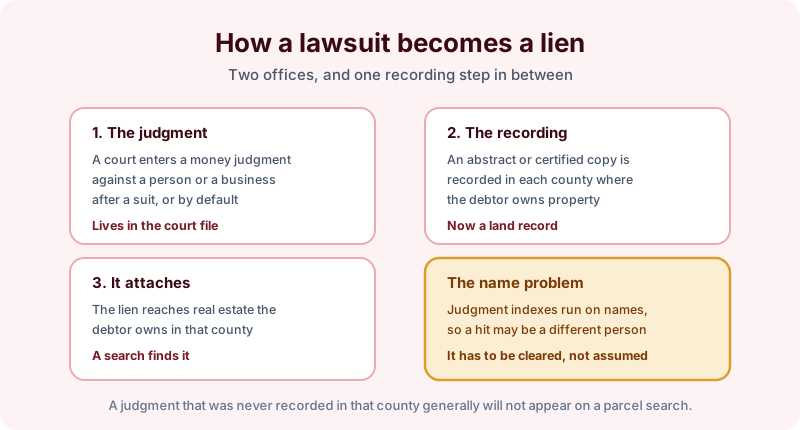
A judgment is a court’s decision that someone owes money. It becomes a problem for a property when a second step happens: the judgment gets recorded in the county where the debtor owns real estate. Until that step, it lives in a court file and generally does not touch the parcel. After it, it is an encumbrance a buyer, lender, or closer has to deal with.
How the lien attaches
A creditor who wins a money judgment records an abstract of judgment, a certified copy, or a similar instrument in the county land records. From that point it operates against real property the debtor owns in that county, and in most places it reaches property the debtor acquires later while the lien remains in force. The mechanics, the duration, and the renewal rules are all state law, and they vary considerably.
Two consequences follow. A judgment entered in one state can end up recorded in several counties, and a judgment entered years ago may still be enforceable if it was renewed. Both are reasons the search runs on names as well as on the parcel.
Where a search picks it up
A title search reviews the land records against the property and the owner names, so a recorded judgment shows up alongside mortgages, tax liens, and HOA liens. Our report gives you the recording date, the parties, the amount stated, and a copy of the instrument, which is what you need to route it to a payoff or a dispute. This is one of the reasons a records search and a lien search are usually the same errand rather than two.
What a parcel search does not do is find a judgment nobody recorded there. A suit pending in another state, a judgment recorded only in the county where the debtor used to live, an unrecorded settlement: those sit outside the land records, and a clean report reflects what was recorded rather than proving no claim exists anywhere.
Why a name hit needs work
Judgment indexes are organized by name, and names repeat. A search on “James R. Miller” in a large county can return several judgments belonging to several different people, which is the same problem covered in our note on name variations in a title search.
Clearing that up is ordinary closing work: compare middle initials, addresses, and dates against what you know about the owner, and obtain copies so the comparison is based on the document. Treating an index hit as the owner’s debt, or dismissing it because the middle name looks wrong, are both ways deals go sideways.
The bottom line
Judgments reach real estate through recording, and recording is exactly what a title search reviews. If you are buying, refinancing, or closing on a property where the owner may have been sued, order the search early enough that a payoff or a dispute can be handled before the closing date rather than at it. Most of our searches come back the same business day, as our note on turnaround explains. Order online, or ask us which product fits if you are not sure whether you need the current owner search or a full chain.