

· AFX Research
Power of Attorney Deeds and Your Title Search
A deed signed by an agent instead of the owner is ordinary and it is also where a surprising share of title defects come from. What the record shows about the authority behind the signature, and which dates decide the question.
Table of Contents
A deed signed by somebody other than the owner is common, legitimate, and quietly one of the more frequent sources of trouble in a chain of title. The deed is never the whole document set — there is an instrument behind it granting the authority, and whether that instrument was recorded, and whether it was still effective on the day of signing, is the actual question.
What the deed itself shows
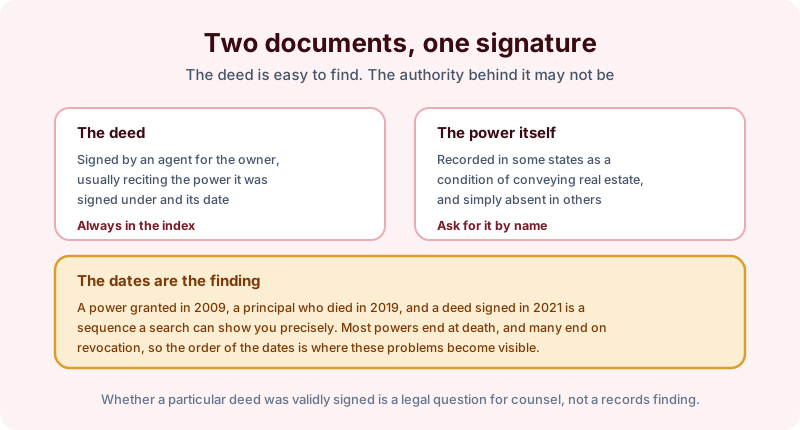
The deed is straightforward to locate: it is indexed like any other, and it normally recites that an agent signed on the owner’s behalf, often naming the power and its date. What it cannot do is prove the agent had authority. That proof lives in the power of attorney, which some states require to be recorded before an agent can convey real estate and others do not.
The four things that go wrong
The power was never recorded. Where local practice or state law expects it, a missing instrument is an exception a future examiner will raise even if everything else was proper.
The power did not cover real property. A document drafted for banking or healthcare decisions may say nothing about conveying land, and a general grant is not automatically a specific one.
The authority had ended. Most powers terminate at the principal’s death, and many terminate on revocation or on a stated date. A deed signed afterward is the classic defect.
The agent was on both sides. An agent conveying the principal’s property to the agent, to a relative, or to an entity they control invites scrutiny, and some states restrict self-dealing outright unless the document authorizes it.
Why the dates matter more than the signatures
A power granted in 2009, a principal who died in 2019, and a deed recorded in 2021 is a sequence a records search shows precisely. That is the real deliverable here: the recording dates, the instrument numbers, and copies. Whether the deed is valid is a conclusion for counsel, but nobody can reach that conclusion without the sequence in front of them. The same order-of-recording logic drives our note on errors found in a title search.
These deeds cluster around estate situations, which is why they overlap with the fact patterns in title search on inherited property, and they often appear alongside the light-warranty conveyances covered in what a quitclaim deed means.
What the search will not decide
It reports what was recorded and indexed in that county over the period searched, with copies. It does not evaluate capacity, it does not tell you whether a power was revoked by an unrecorded document, and it does not confirm the principal was alive on the signing date, which is a vital records question rather than a land records one. An empty result means nothing was recorded, not that nothing exists.
The bottom line
Whenever an agent signs, order the deed and the power together and read the dates in order. Order online, or ask us to pull the power of attorney alongside the deed when you already know an agent was involved.