

· AFX Research
What a Title Search Shows on a Land Bank Property
Land banks exist to hand over clean title, and most of the time they do. Here is what the search should confirm about how the property got there, what conditions ride along with the deed, and which claims survive the clearing.
Table of Contents
Land banks buy, hold, and resell tax-foreclosed and abandoned property, and their whole purpose is to take a parcel nobody could sell and hand it on with usable title. For buyers that is a genuinely good deal. It is not the same thing as a deed with no strings attached, and the strings are recorded, which means a search finds them.
Start with how it got there
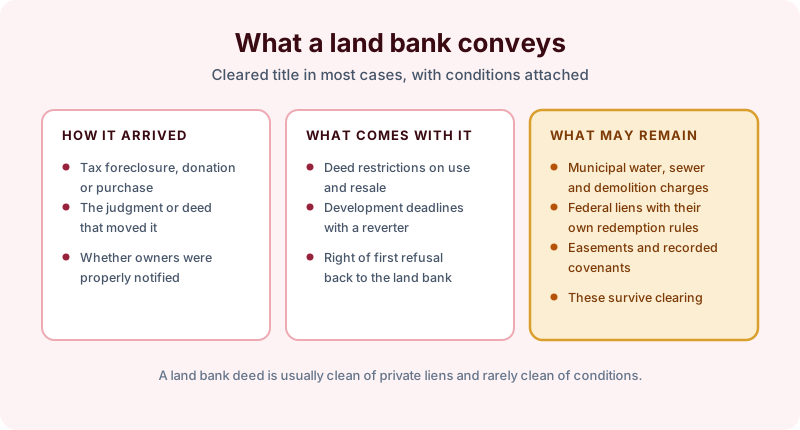
A land bank acquires property by tax foreclosure, by donation, or by purchase, and the route matters because the weakest link in a tax-foreclosed chain is almost always notice. Were the owner, the heirs, and the lienholders properly notified before the foreclosure went through?
That question is the usual ground on which a tax title is later attacked, and it is why the search should reach the judgment or the deed that moved the property into the land bank rather than stopping at the land bank’s own conveyance to you. A land bank that followed its statute carefully leaves that trail in the record, and one that cut a corner leaves a gap you can see. The same reasoning applies to a tax deed sale bought directly.
Read the conditions on the deed
This is where land bank sales differ most from an ordinary purchase, because the deed commonly carries conditions an ordinary seller would never impose.
- Use restrictions. Owner-occupancy requirements, limits on renting, or a bar on resale for a stated period.
- Development deadlines. Build or rehabilitate within twelve or twenty-four months, frequently backed by a reverter that returns the property to the land bank if you miss it.
- A right of first refusal running back to the land bank on any future sale.
None of these is unusual and none of them is hidden — they are recorded, and a search attaches them. They do need reading before closing, because a reverter is an enforceable condition rather than a suggestion, much like the ones covered in deed restrictions and your title search.
What the clearing does not always clear
Most private liens are extinguished by the foreclosure that brought the property in, and that covers old mortgages, judgments and mechanic’s liens. Several categories commonly survive it.
- Municipal water, sewer, and demolition charges, which attach to the parcel and frequently do not appear in a name search at all.
- Federal liens, which carry their own redemption rules.
- Easements and recorded covenants, which are property interests rather than liens and generally remain.
Those are the same survivors that outlast any tax sale, and they are the reason a lien search belongs alongside the chain work.
The takeaway
Buying from a land bank usually does mean cleaner title than buying the same parcel at auction. Confirm how the property came in, read the conditions attached to the deed, and check for the municipal charges that survive. Order online with the parcel number and the land bank’s name, or ask us what a search of that scope would cover before you order.