

· AFX Research
Title Search for a Property Facing Eminent Domain
A condemnation leaves a trail in the county record, and most of it arrives late. What gets recorded before, during and after a taking, and why a partial taking changes the parcel you thought you were buying.
Table of Contents
When a highway is widened or a transmission line is routed, the land records are the last place the project shows up and the first place it matters. A buyer who closes two months before a declaration of taking is recorded owns a different property than the one they inspected, and the money that follows goes to the lienholders before it goes to anybody else.
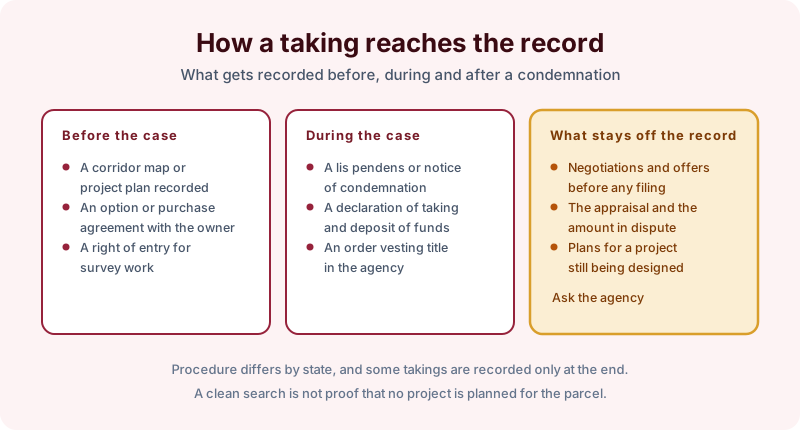
What shows up early
Occasionally something does. A corridor map or project plan may be recorded, an agency may record an option or a purchase agreement with the owner, and a right of entry for survey work sometimes appears. These are the quiet signals, and they turn up most often on rural frontage and along existing rights of way.
They are also easy to misread. A recorded corridor map is a plan rather than a commitment, routes move, and projects are abandoned for funding reasons every year. What the document tells you is that the parcel is inside a study area, which is a reason to ask the agency rather than a reason to walk away.
What shows up during the case
Once a condemnation is filed, the recorded trail gets clearer. Depending on the state you may see a lis pendens or a notice of condemnation, a declaration of taking paired with a deposit of estimated compensation, and eventually an order or judgment vesting title in the agency. In quick take states the title moves at the deposit, well before the compensation is settled.
What a partial taking does
Most takings are partial. A strip off the front, a corner for a turn lane, a permanent easement for a line with a temporary construction easement beside it. Each one leaves the parcel with a new legal description, and the remainder can lose frontage, parking, setback compliance or access. Our note on what a title search cannot find applies with force here, because nothing recorded tells you whether the remainder still works.
Where the money goes
Compensation is paid for the interest taken, and recorded lienholders generally have a claim on it ahead of the owner. A mortgage, a judgment or a tax lien found in the search is therefore not just an encumbrance question but a distribution question, and the same is true of a recorded easement that gets extinguished.
That order matters to a buyer under contract. If the taking happens before closing, the award may be paid to the seller and their lenders, and whether the contract passes it to you is a matter of the contract and of state law. A lis pendens found in the search is the single clearest warning that the question is live.
The takeaway
Order the search, then call the agency. The record will give you the instruments filed so far, with book and page, and it will show the liens that stand to be paid from any award. It will not show a project still in design, an offer that has not been accepted, or an appraisal nobody has filed. Recording practice differs by state and a clean search is not proof that no taking is planned. Order online, or ask us what a search of that scope would cover before anything is ordered.