

· AFX Research
Title Search for a Short Sale Purchase
The seller's lender agreeing to take less is only the first approval a short sale needs, because every junior lienholder can refuse too. Why the complete lien list, in priority order, is the document that decides the deal.
Table of Contents
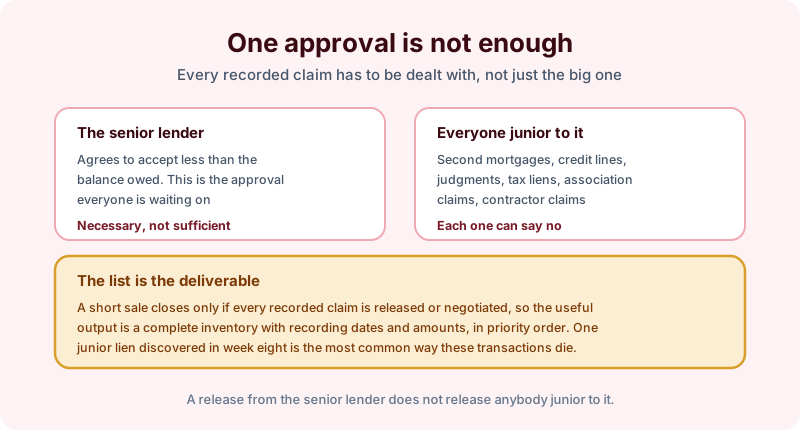
Short sales are usually described as a negotiation with the seller’s lender. That understates it. A short sale closes only if every recorded claim against the property is released or negotiated, and each holder can refuse independently. So the document that actually determines whether the deal is possible is a complete lien inventory, in priority order, produced before anyone spends two months waiting.
Why the search matters more here
In an ordinary sale the payoffs come out of proceeds and nobody has to agree to anything. In a short sale there are not enough proceeds, which turns every lienholder into a party whose consent is required. That changes the search from a verification step into the thing the strategy is built on.
Make the list, then read the order
You want every recorded claim with its recording date and stated amount, arranged by priority. The usual inventory runs: the first mortgage, any second mortgage or credit line, delinquent property taxes, association assessments, judgment liens, contractor claims, and any federal or state tax lien.
Priority is what tells you how hard each one will be. A junior holder facing nothing from a foreclosure has little to lose by cooperating for a small payment, while a well-secured second has real leverage. That distinction is invisible without dates. The difference between a lien-only report and a full search is covered in lien search versus title search.
Every junior claim is a separate negotiation
This is the part sellers and agents underestimate. A release from the senior lender does nothing about anyone junior to it, and each of those holders has its own approval process, its own timeline, and its own view of what a release is worth. Judgment creditors in particular can be slow and unpredictable, as our note on judgment liens describes.
Discovering one of these in week eight is the most common way a short sale dies, and the cost is not just the deal. It is also the months the buyer spent waiting instead of looking at other properties, and that time is not recoverable.
What the search will not decide
It reports what was recorded and indexed in that county over the period searched, with copies. It does not give you payoff figures, which come from each holder, and it does not tell you whether anyone will approve. Nor can it see an unrecorded claim or a balance sitting on a municipality’s or an association’s books with nothing filed.
An empty result means nothing was recorded, not that nothing is owed. If the property is heading toward auction instead, the record work shifts, and title search before a foreclosure auction covers that case.
The bottom line
Order the search at the start, not after the lender responds, and treat the priority-ordered lien list as the deal’s feasibility test. Order online, or ask us to scope a search that captures the junior claims as well as the mortgage.